<?xml version="1.0" encoding="utf-8"?><feed xmlns="http://www.w3.org/2005/Atom" ><generator uri="https://jekyllrb.com/" version="3.10.0">Jekyll</generator><link href="https://dangleuyen.github.io/blog/feed.xml" rel="self" type="application/atom+xml" /><link href="https://dangleuyen.github.io/blog/" rel="alternate" type="text/html" /><updated>2026-07-07T10:28:25+00:00</updated><id>https://dangleuyen.github.io/blog/feed.xml</id><title type="html">Uyen Dang</title><subtitle>better late than never</subtitle><entry><title type="html">PRISMA 2020 (Preferred Reporting Items for Systematic Reviews and Meta-Analyses)</title><link href="https://dangleuyen.github.io/blog/2026/07/05/PRISMA2020/" rel="alternate" type="text/html" title="PRISMA 2020 (Preferred Reporting Items for Systematic Reviews and Meta-Analyses)" /><published>2026-07-05T00:00:00+00:00</published><updated>2026-07-05T00:00:00+00:00</updated><id>https://dangleuyen.github.io/blog/2026/07/05/PRISMA2020</id><content type="html" xml:base="https://dangleuyen.github.io/blog/2026/07/05/PRISMA2020/"><![CDATA[<p>When conducting a systematic literature review (SLR), 
<strong>PRISMA 2020 (Preferred Reporting Items for Systematic Reviews and Meta-Analyses)</strong> is the most widely accepted reporting guideline. 
It provides a transparent and standardized framework for documenting how studies are identified, screened, assessed for eligibility, and included in a systematic review.</p>

<p>PRISMA does not prescribe <em>how</em> to conduct a systematic review. 
Instead, it focuses on <em>how to report</em> the review process clearly so that readers can understand, evaluate, and reproduce the methodology.</p>

<!--more-->

<h2 id="why-use-prisma">Why use PRISMA?</h2>

<p>Following PRISMA helps researchers:</p>

<ul>
  <li>Improve the transparency and reproducibility of their systematic reviews.</li>
  <li>Minimize reporting bias by documenting every stage of the review process.</li>
  <li>Clearly explain how studies were identified, selected, and excluded.</li>
  <li>Increase the credibility and quality of their research.</li>
  <li>Meet the reporting requirements of many journals and conferences.</li>
</ul>

<h2 id="the-prisma-2020-structure">The PRISMA 2020 Structure</h2>

<p>PRISMA 2020 consists of several key components.</p>

<h3 id="1-prisma-2020-checklist">1. PRISMA 2020 Checklist</h3>

<p>The PRISMA 2020 checklist consists of <strong>27 reporting items</strong> organized into seven sections. It helps ensure that every important aspect of a systematic review is reported clearly and transparently.</p>

<table>
  <thead>
    <tr>
      <th>Section</th>
      <th style="text-align: center">Item(s)</th>
      <th>Description</th>
    </tr>
  </thead>
  <tbody>
    <tr>
      <td><strong>Title</strong></td>
      <td style="text-align: center">1</td>
      <td>Identify the report as a systematic review.</td>
    </tr>
    <tr>
      <td><strong>Abstract</strong></td>
      <td style="text-align: center">2</td>
      <td>Provide a structured abstract following the PRISMA 2020 for Abstracts checklist.</td>
    </tr>
    <tr>
      <td><strong>Introduction</strong></td>
      <td style="text-align: center">3–4</td>
      <td>Describe the rationale for the review and clearly state the review objectives or research questions.</td>
    </tr>
    <tr>
      <td><strong>Methods</strong></td>
      <td style="text-align: center">5–15</td>
      <td>Report eligibility criteria, information sources, search strategy, selection process, data collection, data items, risk of bias assessment, effect measures, synthesis methods, reporting bias assessment, and certainty assessment.</td>
    </tr>
    <tr>
      <td><strong>Results</strong></td>
      <td style="text-align: center">16–22</td>
      <td>Describe study selection, study characteristics, risk of bias, individual study results, synthesis results, reporting bias, and certainty of evidence.</td>
    </tr>
    <tr>
      <td><strong>Discussion</strong></td>
      <td style="text-align: center">23</td>
      <td>Interpret the findings, discuss limitations of both the included evidence and the review process, and suggest implications for future research.</td>
    </tr>
    <tr>
      <td><strong>Other Information</strong></td>
      <td style="text-align: center">24–27</td>
      <td>Report registration details, protocol, sources of financial or non-financial support, competing interests, and availability of data, code, and other materials.</td>
    </tr>
  </tbody>
</table>

<p>Rather than being a writing template, the checklist serves as a quality assurance tool to ensure that no important information is omitted.</p>

<h4 id="prisma-2020-for-abstracts-checklist">PRISMA 2020 for Abstracts checklist</h4>

<table>
  <thead>
    <tr>
      <th>Section</th>
      <th style="text-align: center">Item(s)</th>
      <th>Description</th>
    </tr>
  </thead>
  <tbody>
    <tr>
      <td><strong>Title</strong></td>
      <td style="text-align: center">1</td>
      <td>Identify the report as a systematic review.</td>
    </tr>
    <tr>
      <td><strong>Background</strong></td>
      <td style="text-align: center">2</td>
      <td>State the main objective or research question addressed by the review.</td>
    </tr>
    <tr>
      <td><strong>Methods</strong></td>
      <td style="text-align: center">3–6</td>
      <td>Describe the eligibility criteria, information sources (e.g., databases), date of the last search, and methods used to assess the risk of bias in the included studies.</td>
    </tr>
    <tr>
      <td><strong>Results</strong></td>
      <td style="text-align: center">7–10</td>
      <td>Report the number and characteristics of included studies, summarize the main findings, describe the limitations of the evidence, and provide an interpretation of the results.</td>
    </tr>
    <tr>
      <td><strong>Other</strong></td>
      <td style="text-align: center">11–12</td>
      <td>Report the primary source of funding and provide the registration number and registry name (if applicable).</td>
    </tr>
  </tbody>
</table>

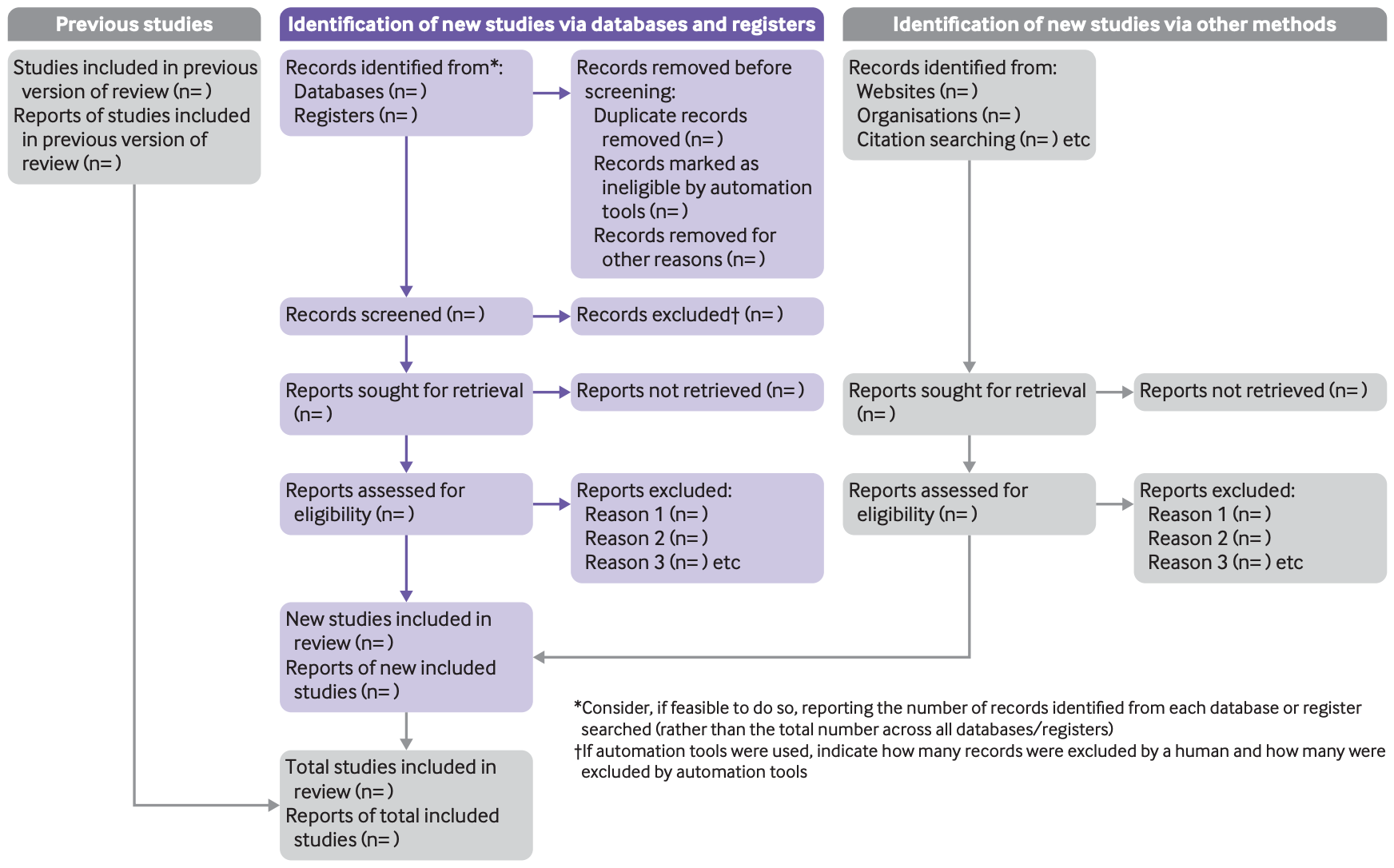
<h3 id="2-prisma-flow-diagram">2. PRISMA Flow Diagram</h3>

<p><img src="/blog/assets/image/PRISMA_flow.png" alt="PRISMA 2020 Flow Diagram" width="700" /></p>

<p>The flow diagram helps readers quickly understand how the final set of studies was obtained, typically including three stages:</p>

<p>– Records previous studies
– Identify new study through database and registers.
– Identify new study through other methods.</p>

<h2 id="is-prisma-enough">Is PRISMA Enough?</h2>

<p>PRISMA provides an framework for reporting systematic reviews, but it is only one part of the review process.</p>

<p>Researchers still need to carefully:</p>
<ul>
  <li>Define research questions.</li>
  <li>Develop a search strategy.</li>
  <li>Select appropriate databases.</li>
  <li>Screen studies systematically.</li>
  <li>Assess study quality.</li>
  <li>Synthesize the evidence.</li>
</ul>

<p>In other words, PRISMA tells readers <strong>what should be reported</strong>, not <strong>how to perform every step</strong> of the review.</p>

<h2 id="final-thoughts">Final Thoughts</h2>

<p>If you are new to systematic literature reviews, learning PRISMA 2020 is a great starting point. It has become the reporting standard adopted by thousands of journals across medicine, computer science, engineering, education, psychology, and many other disciplines.</p>

<p>Whether you are conducting your first literature review or preparing a manuscript for publication, following PRISMA will help make your review more transparent, reproducible, and trustworthy.</p>

<h2 id="references">References</h2>

<ul>
  <li>Page, M. J., McKenzie, J. E., Bossuyt, P. M., Boutron, I., Hoffmann, T. C., Mulrow, C. D., … &amp; Moher, D. (2021). The PRISMA 2020 statement: an updated guideline for reporting systematic reviews. bmj, 372.</li>
  <li>Page, M. J., Moher, D., Bossuyt, P. M., Boutron, I., Hoffmann, T. C., Mulrow, C. D., … &amp; McKenzie, J. E. (2021). PRISMA 2020 explanation and elaboration: updated guidance and exemplars for reporting systematic reviews. bmj, 372.</li>
</ul>]]></content><author><name></name></author><category term="Research" /><summary type="html"><![CDATA[When conducting a systematic literature review (SLR), PRISMA 2020 (Preferred Reporting Items for Systematic Reviews and Meta-Analyses) is the most widely accepted reporting guideline. It provides a transparent and standardized framework for documenting how studies are identified, screened, assessed for eligibility, and included in a systematic review. PRISMA does not prescribe how to conduct a systematic review. Instead, it focuses on how to report the review process clearly so that readers can understand, evaluate, and reproduce the methodology.]]></summary></entry><entry><title type="html">English Vocabulary Journal</title><link href="https://dangleuyen.github.io/blog/2026/07/02/ELVocab/" rel="alternate" type="text/html" title="English Vocabulary Journal" /><published>2026-07-02T00:00:00+00:00</published><updated>2026-07-02T00:00:00+00:00</updated><id>https://dangleuyen.github.io/blog/2026/07/02/ELVocab</id><content type="html" xml:base="https://dangleuyen.github.io/blog/2026/07/02/ELVocab/"><![CDATA[<p>This post is my personal English vocabulary journal. Whenever I learn a new word, phrase, phrasal verb, or idiom, I’ll add it here. My goal is to review these expressions regularly and expand my vocabulary over time.</p>

<!--more-->

<p><strong>1. knock it out of the park</strong> (idiom) 
This idiom means to do something exceptionally well or achieve outstanding success. It is commonly used to praise someone’s performance, presentation, project, or achievement.
For example,</p>
<ul>
  <li><em>You really knocked it out of the park with your presentation today.</em></li>
  <li><em>Our team knocked it out of the park and finished the project ahead of schedule.</em></li>
</ul>

<p><strong>2. down to the wire</strong> (idiom) 
This idiom means that a situation continues until the very last moment, often under a tight deadline or with a very close result.
For example:</p>

<ul>
  <li><em>Since our client changed the requirements at the last minute, our team was working right down to the wire to finish the project on time.</em></li>
  <li><em>The competion goes down to the wire and every competitor can still win.</em></li>
</ul>

<p><strong>3. kick something off</strong> (phrasal verb)
This means to begin or start something, particularly an event, meeting, project, or activity. For example, instead of saying “We finished a plan, and now we can start it”, you can say “We finished the plan. Now let’s kick it off.”
Other examples,</p>
<ul>
  <li><em>Let’s kick off the meeting with a quick introduction.</em></li>
  <li><em>The company kicked off the new project last week.</em></li>
  <li><em>The football season kicks off in August.</em></li>
</ul>

<p><strong>4. keep an eye on something/someone</strong> (idiom) 
This means to watch or take care of something or someone, especially to make sure everything will be okay. For example,</p>
<ul>
  <li><em>Please keep an eye on the frying chicken to make sure it doesn’t burn.</em></li>
  <li><em>Can you keep an eye on your little brother while I go out?</em></li>
  <li><em>Could you keep an eye on my bag while I grab a coffee?</em></li>
</ul>

<p><strong>5. take it easy</strong> (idiom) 
This means to relax, avoid stress, or not work too hard. For example,</p>
<ul>
  <li><em>Take it easy. You’ve studied very hard. Now we are just waiting for the final assessment.</em></li>
  <li><em>We often work hard during the week and take it easy on the weekends.</em></li>
  <li><em>You’ve been working all day. Take it easy and get some rest.</em></li>
  <li><em>I’m planning to take it easy this weekend and go for a walk in nature.</em></li>
</ul>

<p><strong>6. eat like a horse</strong> (idiom) 
This means that you eat a very large amount of food, usually because you are extremely hungry.</p>
<ul>
  <li><em>I skipped breakfast because I woke up late. Now I’m starving—I could eat like a horse.</em></li>
  <li><em>After hiking all day, we ate like horses.</em></li>
</ul>

<p><strong>7. sleep like a log</strong> (idiom)
This means that you sleep deeply and very well</p>
<ul>
  <li><em>I slept like a log last night because I had worked hard all day.</em></li>
  <li><em>The kids were so tired after the camping trip that they slept like logs.</em></li>
  <li><em>I wish I could sleep like a log, just like my baby.</em></li>
</ul>

<p><strong>8. get back to someone</strong> (phrasal verb)
This means to contact or reply to someone later, usually because you need more time or are busy at the moment.</p>

<ul>
  <li><em>Let me check my calendar. I’ll get back to you later.</em></li>
  <li><em>I’m not available right now. I’ll get back to you tonight.</em></li>
  <li><em>I’ll get back to you once I’ve spoken to my manager.</em></li>
</ul>

<p><strong>9. break the ice</strong> (idiom)
This means to do or say something that helps people feel more relaxed and comfortable, especially when they are meeting for the first time.</p>

<ul>
  <li><em>I’m responsible for breaking the ice at the beginning of the event, so let’s kick it off with a fun game.</em></li>
  <li><em>She’s great at breaking the ice and helping people feel comfortable, especially when they’re nervous.</em></li>
  <li><em>The teacher told a funny story to break the ice on the first day of class.</em></li>
  <li><em>We played a simple game to break the ice before the meeting started.</em></li>
</ul>

<p><strong>10. don’t put all your eggs in one basket</strong> (idiom)
This idiom means you should not risk everything on a single plan, option, or opportunity, because if it fails, you may lose everything. It encourages diversification and caution.</p>
<ul>
  <li><em>I’m applying to several universities because I don’t want to put all my eggs in one basket.</em></li>
  <li><em>Investors are advised not to put all their eggs in one basket.</em></li>
</ul>

<p><strong>11. so far, so good</strong> (idiom)
This means that you are satisfied until the current moment</p>
<ul>
  <li><em>My project is going well so far. So far, so good.</em></li>
  <li><em>We’ve completed half of the experiment, and so far, so good.</em></li>
  <li><em>The journey has been long, but so far, so good.</em></li>
</ul>

<p><strong>12. behind someone’s back</strong> (idiom)</p>

<p>This idiom means to do something secretly without someone knowing, especially in a way that is unfair, dishonest, or disrespectful.</p>
<ul>
  <li><em>You shouldn’t talk about her behind her back.</em></li>
  <li><em>It’s not right to make decisions behind your manager’s back.</em></li>
</ul>

<p><strong>13. home from home</strong> (idiom)
This idiom describes a place that is so comfortable and welcoming that it feels like your own home.</p>

<ul>
  <li><em>This hotel feels like a home from home.</em></li>
  <li><em>After living abroad for several years, the local café became my home from home.</em></li>
  <li><em>My grandparents’ house has always been a home from home for me.</em></li>
</ul>

<p><strong>14. under the weather</strong> (idiom)
This idiom means to feel slightly ill, unwell, or not in good health.</p>
<ul>
  <li><em>I’m feeling a bit under the weather today, so I’ll stay home and rest.</em></li>
  <li><em>She was under the weather last week and missed a few days of work.</em></li>
  <li><em>I’ve been feeling under the weather since yesterday.</em></li>
</ul>

<p><strong>15. die laughing</strong> (idiom)
This idiom means to laugh so hard that you can hardly control yourself. It is an exaggeration and does not mean someone actually dies.</p>
<ul>
  <li><em>I nearly died laughing when my friends used AI to teach me different languages.</em></li>
  <li><em>We were all dying laughing at his jokes.</em></li>
  <li><em>The comedy show was so funny that I thought I was going to die laughing.</em></li>
</ul>]]></content><author><name></name></author><category term="English" /><summary type="html"><![CDATA[This post is my personal English vocabulary journal. Whenever I learn a new word, phrase, phrasal verb, or idiom, I’ll add it here. My goal is to review these expressions regularly and expand my vocabulary over time.]]></summary></entry><entry><title type="html">Critical Thinking</title><link href="https://dangleuyen.github.io/blog/2026/06/30/CriticalThinking/" rel="alternate" type="text/html" title="Critical Thinking" /><published>2026-06-30T00:00:00+00:00</published><updated>2026-06-30T00:00:00+00:00</updated><id>https://dangleuyen.github.io/blog/2026/06/30/CriticalThinking</id><content type="html" xml:base="https://dangleuyen.github.io/blog/2026/06/30/CriticalThinking/"><![CDATA[<p>Throughout our lives and careers, we’re constantly taught what to think.</p>

<p>Follow these procedures. Apply these frameworks. Use these techniques. Do it this way.</p>

<p>Knowing what to think is important. But knowing how to think is what truly helps us solve problems, make better decisions, and adapt to new situations.</p>

<p>Three thinking skills are especially valuable in today’s world: <strong>critical thinking, creative thinking</strong>, and <strong>strategic thinking</strong>. Although they are closely related, each serves a different purpose.</p>

<!--more-->

<h3 id="1-what-is-critical-thinking">1. What is critical thinking?</h3>
<p>Critical thinking is the ability to think clearly, objectively, and logically. Rather than accepting information at face value, critical thinkers question assumptions, evaluate evidence, and consider different perspectives before reaching a conclusion.</p>

<p>It is not our natural or default way of thinking. Our brains often rely on intuition, habits, or emotions because they are faster and require less effort. Critical thinking, on the other hand, is a skill that requires conscious practice—and one that anyone can develop over time.</p>

<p>Whether you’re reading the news, making an important decision, or solving a problem at work, critical thinking helps you separate facts from opinions and make more informed judgments.</p>

<h3 id="2-critical-thinking-vs-creative-thinking-vs-strategic-thinking">2. Critical thinking vs Creative thinking vs Strategic thinking</h3>
<h4 id="critical-thinking">Critical thinking</h4>
<p>Critical thinking is about evaluating information to determine whether it is accurate, reliable, and relevant. It helps you make rational decisions about what to believe or what action to take.</p>

<p>A critical thinker asks questions such as:</p>
<ul>
  <li><em>Is this information supported by evidence?</em></li>
  <li><em>How do we know this is true?</em></li>
  <li><em>What assumptions are being made?</em></li>
  <li><em>Could there be another explanation?</em></li>
</ul>

<p>Whenever you’re verifying facts, assessing evidence, identifying logical fallacies, recognizing biases, or questioning assumptions, you’re using critical thinking.</p>

<h4 id="creative-thinking">Creative thinking</h4>
<p>Creative thinking is about generating new possibilities. It encourages you to look at challenges from different perspectives and imagine solutions that may not be immediately obvious.</p>

<p>A creative thinker asks:</p>

<ul>
  <li><em>What if we approached this differently?</em></li>
  <li><em>Can we combine these ideas in a new way?</em></li>
  <li><em>Is there a completely different solution?</em></li>
</ul>

<p>Whenever you’re brainstorming ideas, experimenting with new approaches, or thinking outside the box, you’re using creative thinking.</p>

<h4 id="strategic-thinking">Strategic thinking</h4>
<p>Strategic thinking is about connecting ideas to achieve long-term goals. It focuses on choosing the best path forward by considering priorities, constraints, opportunities, and future consequences.</p>

<p>A strategic thinker asks questions such as:</p>

<ul>
  <li><em>Why are we doing this?</em></li>
  <li><em>How does this support our long-term objectives?</em></li>
  <li><em>What obstacles might we face?</em></li>
  <li><em>Which option will create the greatest impact?</em></li>
</ul>

<p>Whenever you’re identifying patterns, analyzing trends, weighing trade-offs, or planning for the future, you’re using strategic thinking.</p>

<h3 id="3-recognizing-these-types-of-thinking">3. Recognizing these types of thinking</h3>
<p>Imagine you’re working for a company that wants to improve building security. An employee proposes using facial recognition technology instead of traditional key cards.</p>

<p>The manager asks, <em>“Why do you think facial recognition is the best option?”</em></p>

<p>The employee responds that it would allow staff to enter the building more quickly, reduce the risk of lost access cards, and improve overall security.</p>

<p>Different thinking styles would approach the proposal in different ways.</p>

<h4 id="critical-thinking-1">Critical Thinking</h4>

<p>A critical thinker evaluates whether the proposal is supported by evidence.</p>

<p>They might ask:</p>

<ul>
  <li><em>Is facial recognition actually more accurate than key cards?</em></li>
  <li><em>What evidence supports these claims?</em></li>
  <li><em>Are there privacy or ethical concerns?</em></li>
  <li><em>What happens if the system incorrectly identifies someone?</em></li>
  <li><em>What are the potential risks and limitations?</em></li>
</ul>

<p>The goal is to determine whether the proposal is valid and well supported.</p>

<h4 id="creative-thinking-1">Creative Thinking</h4>

<p>A creative thinker explores alternative possibilities.</p>

<p>They might ask:</p>

<ul>
  <li><em>Could we combine facial recognition with another authentication method?</em></li>
  <li><em>Is there a completely different technology that would work even better?</em></li>
  <li><em>How might we redesign the employee check-in experience?</em></li>
</ul>

<p>The goal is to generate new ideas rather than evaluate existing ones.</p>

<h4 id="strategic-thinking-1">Strategic Thinking</h4>

<p>A strategic thinker considers how the decision fits into the organization’s broader objectives.</p>

<p>They might ask:</p>

<ul>
  <li><em>Does this solution align with our long-term security strategy?</em></li>
  <li><em>Is the investment worth the expected benefits?</em></li>
  <li><em>How difficult will it be to maintain the system?</em></li>
  <li><em>How will employees respond to this change?</em></li>
  <li><em>Will this technology still meet our needs five years from now?</em></li>
</ul>

<p>The goal is to choose the solution that creates the greatest long-term value.</p>

<h3 id="final-thoughts">Final Thoughts</h3>

<p>Strong thinkers don’t rely on just one way of thinking—they know when to use each one.</p>

<ul>
  <li>Critical thinking helps you judge whether information is trustworthy.</li>
  <li>Creative thinking helps you generate innovative ideas.</li>
  <li>Strategic thinking helps you choose the best path toward your goals.</li>
</ul>

<p>The next time you’re faced with a problem, ask yourself: <em>Am I trying to evaluate, create, or decide?</em></p>

<p>The answer will help you choose the thinking skill that’s most useful in that moment.</p>

<p><strong>Reference</strong></p>

<p>This article is based on concepts from the LinkedIn Learning course <em>Critical Thinking</em>.</p>]]></content><author><name></name></author><category term="Soft-Skills" /><summary type="html"><![CDATA[Throughout our lives and careers, we’re constantly taught what to think. Follow these procedures. Apply these frameworks. Use these techniques. Do it this way. Knowing what to think is important. But knowing how to think is what truly helps us solve problems, make better decisions, and adapt to new situations. Three thinking skills are especially valuable in today’s world: critical thinking, creative thinking, and strategic thinking. Although they are closely related, each serves a different purpose.]]></summary></entry><entry><title type="html">Handling disagreements</title><link href="https://dangleuyen.github.io/blog/2026/06/29/HandlingDisagreements/" rel="alternate" type="text/html" title="Handling disagreements" /><published>2026-06-29T00:00:00+00:00</published><updated>2026-06-29T00:00:00+00:00</updated><id>https://dangleuyen.github.io/blog/2026/06/29/HandlingDisagreements</id><content type="html" xml:base="https://dangleuyen.github.io/blog/2026/06/29/HandlingDisagreements/"><![CDATA[<p>When you have conversations at work or in daily life, differences in opinions are inevitable. People bring different experiences, values, and perspectives to the discussion, so conflicts of ideas naturally arise. The key is not to avoid disagreements, but to express your own viewpoint respectfully while maintaining a positive relationship.</p>

<!--more-->

<h3 id="1-assess-the-situation">1. Assess the situation</h3>
<p>There is no one-size-fits-all approach to handling disagreements. Before responding, take a moment to assess the situation from two important perspectives.</p>

<ul>
  <li>
    <p><strong>Evaluate the relationship.</strong> Consider how important your relationship with the other person is. Is it a close colleague, your manager, a client, or a friend? Think about your long-term goal. Sometimes preserving trust and collaboration is more valuable than proving you’re right.</p>
  </li>
  <li>
    <p><strong>Consider the power dynamics.</strong> Be aware of the context and each person’s role. Disagreeing with a peer may require a different approach than disagreeing with a supervisor or someone you manage. Understanding the power dynamics helps you choose an appropriate tone and communication style while still expressing your ideas confidently.</p>
  </li>
</ul>

<h3 id="2-practice-to-handle-disagreements">2. Practice to handle disagreements</h3>

<h4 id="prepare">Prepare</h4>
<p>Before entering the conversation, take time to examine your own thinking.</p>

<ul>
  <li>You can list some possible assumptions that you’re making.</li>
  <li>Then make a list of three positive intents that the person my have.</li>
  <li>Approaching the discussion with curiosity rather than certainty makes it easier to have a productive conversation.</li>
</ul>

<h4 id="pace">Pace</h4>
<p>During the conversation, slow down and focus on understanding before responding.</p>

<ul>
  <li>Ask open-ended questions to understand the other person’s perspective.</li>
  <li>Acknowledge their viewpoint and show appreciation for their reasoning, even if you disagree.</li>
  <li>Explain your own perspective calmly, using facts, evidence, and reasoning instead of assumptions or personal judgments.</li>
  <li>Listen carefully without interrupting, and remain open to changing your mind if new information emerges.</li>
</ul>

<p><em>Listen intently, hold your position lightly, and express appreciation generously.</em></p>

<h4 id="process">Process</h4>
<p>Once everyone’s viewpoints have been shared, shift the conversation toward finding a solution.</p>

<ul>
  <li>Instead of asking <em>“Who is right?”</em>, ask:
    <ul>
      <li><em>What problem are we trying to solve?</em></li>
      <li><em>What do we agree on?</em></li>
      <li><em>What action can we take together?</em></li>
    </ul>
  </li>
  <li>After the conversation, spend a few minutes reflecting.
    <ul>
      <li><em>What went well?</em></li>
      <li><em>What could you have communicated more effectively?</em></li>
      <li><em>What will you do differently next time?</em></li>
    </ul>
  </li>
</ul>

<p>Every disagreement is an opportunity to strengthen your communication skills and build better relationships.</p>

<h4 id="final-thoughts">Final Thoughts</h4>

<p>Disagreements are not signs of poor communication—they are opportunities to learn, collaborate, and make better decisions. By assessing the situation, preparing thoughtfully, communicating with empathy, and focusing on problem-solving, you can express your opinions confidently without damaging relationships.</p>

<p>Remember, the goal is rarely to <strong>win the argument</strong>. The goal is to <strong>understand each other well enough to move forward together</strong>.</p>

<h4 id="reference">Reference</h4>

<p>This article is based on concepts from the LinkedIn Learning course <em>Communication Foundations</em>.</p>]]></content><author><name></name></author><category term="Soft-Skills" /><summary type="html"><![CDATA[When you have conversations at work or in daily life, differences in opinions are inevitable. People bring different experiences, values, and perspectives to the discussion, so conflicts of ideas naturally arise. The key is not to avoid disagreements, but to express your own viewpoint respectfully while maintaining a positive relationship.]]></summary></entry><entry><title type="html">BREATHE - A Simple Framework to Overcome Public Speaking Anxiety</title><link href="https://dangleuyen.github.io/blog/2026/06/27/BreatheTechnique/" rel="alternate" type="text/html" title="BREATHE - A Simple Framework to Overcome Public Speaking Anxiety" /><published>2026-06-27T00:00:00+00:00</published><updated>2026-06-27T00:00:00+00:00</updated><id>https://dangleuyen.github.io/blog/2026/06/27/BreatheTechnique</id><content type="html" xml:base="https://dangleuyen.github.io/blog/2026/06/27/BreatheTechnique/"><![CDATA[<p>Speaking in public or presenting your ideas to an audience—especially executives or professionals—can be intimidating. Your heart races, your palms become sweaty, and your mind may suddenly go blank. 
The good news is that nervousness is completely normal, and it can be managed. One practical framework is BREATHE, an acronym that helps you remember seven techniques to reduce anxiety and build confidence before and during a presentation.</p>

<!--more-->

<ul>
  <li><strong>B</strong>: Breath</li>
  <li><strong>R</strong>: Reframe internal dialogue</li>
  <li><strong>E</strong>: Ease into fear</li>
  <li><strong>A</strong>: Alternate practice</li>
  <li><strong>T</strong>: Terminate negative self talk</li>
  <li><strong>H</strong>: Heart rate up</li>
  <li><strong>E</strong>: Empathize</li>
</ul>

<h3 id="1-breath">1. Breath</h3>
<p>Before stepping onto the stage or beginning your presentation, find a quiet place if possible. Stretch your body, stand in a confident posture, and take several slow, deep breaths.</p>

<p>Deep breathing calms your nervous system, reduces stress, and helps you feel more composed before facing your audience.</p>

<h3 id="2-reframe-internal-dialogue">2. Reframe internal dialogue</h3>
<p>When you’re nervous, you may notice physical sensations such as a racing heart, shaky hands, or sweaty palms. Interestingly, these are the same physiological responses your body experiences when you’re excited.</p>

<p>Instead of telling yourself, <em>“I’m so nervous,”</em> try saying: <em>“I’m excited about sharing my ideas.”</em>
This small shift in mindset can transform anxiety into positive energy.</p>

<h3 id="3-ease-into-your-fear">3. Ease into your fear</h3>
<p>Confidence develops through gradual exposure.</p>

<p>If speaking in front of a large audience feels overwhelming, start small. Speak to a trusted friend, then to a small group, and gradually work your way up to larger audiences. If entering a crowded room feels intimidating, begin by standing near the back, then slowly move toward the center, and eventually become comfortable speaking at the front.</p>

<p>Taking small, manageable steps helps desensitize your fear over time.</p>

<h3 id="4-alternate-your-practice">4. Alternate your practice</h3>
<p>Practice in different ways to prepare yourself for real presentations.</p>

<p>For example, you can:</p>

<ul>
  <li>Rehearse your presentation alone.</li>
  <li>Record yourself and watch the recording to identify areas for improvement.</li>
  <li>Present to friends, classmates, or colleagues and ask for feedback.</li>
  <li>Practice in different environments so you become comfortable adapting to new situations.</li>
</ul>

<p>The more varied your practice, the more confident you’ll feel on presentation day.</p>

<h3 id="5-terminate-your-negative-self-talk">5. Terminate your negative self talk</h3>
<p>Our thoughts influence our confidence.</p>

<p>When negative thoughts appear, consciously replace them with constructive ones.</p>

<p>Instead of thinking:
<em>“I’d rather die than give this presentation.”</em>
Try saying:
<em>“This presentation is an opportunity to improve my communication skills.”</em>
or
<em>“The feedback I receive will help me become a better presenter.”</em></p>

<p>Replacing negative self-talk with realistic, encouraging thoughts can significantly reduce anxiety.</p>

<h3 id="6-heart-rate-up">6. Heart rate up</h3>
<p>Presentation anxiety naturally increases your heart rate. Rather than avoiding this feeling, prepare for it.</p>

<p>Before practicing, try climbing a few flights of stairs or doing light exercise to elevate your heart rate. Then rehearse your presentation.</p>

<p>This helps you become comfortable speaking clearly even when your body is under mild stress, making it easier to stay composed during the real presentation.</p>

<h3 id="7-empathize">7. Empathize</h3>
<p>One of the most effective ways to reduce anxiety is to shift your focus away from yourself.</p>

<p>Instead of worrying about how you look or sound, think about your audience.</p>

<p>Ask yourself:</p>
<ul>
  <li><em>What do they need?</em></li>
  <li><em>How can my presentation help them?</em></li>
  <li><em>What value can I provide?</em></li>
</ul>

<p>When your attention is on helping others rather than judging yourself, your fear naturally begins to fade.</p>

<h4 id="final-thoughts">Final Thoughts</h4>

<p>No one is born a confident public speaker. Confidence is built through preparation, practice, and experience.</p>

<p>The next time you feel nervous before a presentation, remember to <strong>BREATHE</strong>.</p>

<p>With consistent practice, you’ll discover that confidence isn’t the absence of fear—it’s learning how to speak despite it.</p>

<h4 id="reference">Reference</h4>

<p>This article is based on concepts from the LinkedIn Learning course <em>Communication Foundations</em>.</p>]]></content><author><name></name></author><category term="Soft-Skills" /><summary type="html"><![CDATA[Speaking in public or presenting your ideas to an audience—especially executives or professionals—can be intimidating. Your heart races, your palms become sweaty, and your mind may suddenly go blank. The good news is that nervousness is completely normal, and it can be managed. One practical framework is BREATHE, an acronym that helps you remember seven techniques to reduce anxiety and build confidence before and during a presentation.]]></summary></entry><entry><title type="html">Self-Efficacy</title><link href="https://dangleuyen.github.io/blog/2026/06/25/selfEfficacy/" rel="alternate" type="text/html" title="Self-Efficacy" /><published>2026-06-25T00:00:00+00:00</published><updated>2026-06-25T00:00:00+00:00</updated><id>https://dangleuyen.github.io/blog/2026/06/25/selfEfficacy</id><content type="html" xml:base="https://dangleuyen.github.io/blog/2026/06/25/selfEfficacy/"><![CDATA[<p>Self-efficacy is a psychological concept introduced by Albert Bandura in his 1997 book <strong>Self-Efficacy: The Exercise of Control</strong> [1]. It refers to a person’s belief in their ability to organize and execute the actions required to achieve a specific goal or perform a particular task. In other words, self-efficacy is not about the skills you have, but about your confidence in using those skills effectively when facing challenges.</p>

<!--more-->

<h3 id="1-what-is-self-efficacy">1. What is Self-Efficacy?</h3>
<p>Simply put, self-efficacy is your belief in your ability to achieve a specific goal or complete a particular task.</p>

<p>For example, imagine that you are usually too shy to speak up in class. At the same time, you know that communication skills are important, and you want to improve yours. One day, you decide to change your behavior by raising your hand and sharing your thoughts during a class discussion.</p>

<p>At first, your heart beats rapidly, and you feel nervous about speaking in front of others. However, you keep telling yourself, “I can do it.” After repeating this encouragement several times, you gather the courage to raise your hand and express your ideas.</p>

<p>In that moment, your belief that you can overcome your fear and speak in public is an example of self-efficacy. The stronger your self-efficacy, the more likely you are to take on challenges, persist through difficulties, and achieve your goals.</p>

<h3 id="2-sources-of-self-efficacy">2. Sources of Self-Efficacy</h3>
<p>Four sources of self-efficacy you can apply to boost your confidence. They are <strong>mastery experiences</strong>, <strong>vicarious experiences</strong>, <strong>verbal persuasion</strong>, and <strong>physiological &amp; emotional feedback</strong>.</p>
<h4 id="21-mastery-experiences">2.1 Mastery Experiences</h4>
<p>Mastery experiences are the most powerful source of self-efficacy. When you successfully complete a task, you gain evidence that you are capable of doing it again in the future.</p>

<p>For example, children learn basic mathematics by solving similar types of problems repeatedly. As they accumulate successful experiences, they become more confident in their mathematical abilities. Likewise, if you regularly practice public speaking, each successful presentation will strengthen your belief that you can speak confidently in front of an audience.</p>

<p>The key idea is simple: success builds confidence.</p>

<h4 id="22-vicarious-experiences">2.2 Vicarious Experiences</h4>
<p>Vicarious experiences (also called role modeling) occur when you observe others successfully performing a task. Seeing someone similar to yourself succeed can increase your belief that you can succeed as well.</p>

<p>For example, a student who is nervous about giving presentations may gain confidence after watching a classmate deliver an effective presentation. If the classmate can do it, the student may think, “Perhaps I can do it too.”</p>

<p>This is one reason why role models and mentors can have such a powerful influence on our confidence and motivation.</p>

<h4 id="23-verbal-persuasion">2.3 Verbal Persuasion</h4>
<p>Verbal persuasion refers to encouragement and positive feedback from others. When people express confidence in your abilities, you are more likely to believe in yourself and put in the effort required to succeed.</p>

<p>For example, a teacher might tell a student, “You have prepared well for this presentation. I believe you will do a great job.” Such encouragement can reduce self-doubt and motivate the student to perform at their best.</p>

<p>While encouragement alone cannot guarantee success, it can provide the confidence needed to take the first step.</p>

<h4 id="24-physiological--emotional-feedback">2.4 Physiological &amp; Emotional Feedback</h4>
<p>People often interpret their physical and emotional states as signals about their abilities. Feelings such as stress, anxiety, excitement, or calmness can influence self-efficacy.</p>

<p>For example, before giving a presentation, a student may notice a racing heart and sweaty palms. If the student interprets these sensations as signs of failure, their confidence may decrease. However, if they view these feelings as normal excitement before an important event, they may feel more capable and confident.</p>

<p>Learning to manage stress and regulate emotions can therefore help strengthen self-efficacy and improve performance.</p>

<h4 id="references">References</h4>
<p>[1] Bandura, A. (1997). Self-efficacy: The exercise of control (Vol. 11). Freeman.</p>]]></content><author><name></name></author><category term="Soft-Skills" /><summary type="html"><![CDATA[Self-efficacy is a psychological concept introduced by Albert Bandura in his 1997 book Self-Efficacy: The Exercise of Control [1]. It refers to a person’s belief in their ability to organize and execute the actions required to achieve a specific goal or perform a particular task. In other words, self-efficacy is not about the skills you have, but about your confidence in using those skills effectively when facing challenges.]]></summary></entry><entry><title type="html">YOLOv1 - YOLOv4</title><link href="https://dangleuyen.github.io/blog/2026/04/25/yolo1/" rel="alternate" type="text/html" title="YOLOv1 - YOLOv4" /><published>2026-04-25T00:00:00+00:00</published><updated>2026-04-25T00:00:00+00:00</updated><id>https://dangleuyen.github.io/blog/2026/04/25/yolo1</id><content type="html" xml:base="https://dangleuyen.github.io/blog/2026/04/25/yolo1/"><![CDATA[<!--more-->

<h3 id="1-introduction-to-yolo">1. Introduction to YOLO</h3>
<p>YOLO (You Only Look Once) was introduced by Joseph Redmon, Santosh Divvala, Ross Girshick, and Ali Farhadi in 2015 as a fast and efficient method for object detection. Unlike 2-stage approaches such as R-CNN, which first generate potential object regions and then classify them, YOLO does everything in a single step. It looks at the entire image once and directly predicts both the bounding boxes and the types of objects.
Because of this one-step approach, YOLO is much faster and uses fewer computational resources, making it ideal for real-time applications like video analysis and surveillance.</p>

<h3 id="2-evolution-of-yolo-yolov1---yolov4">2. Evolution of YOLO (YOLOv1 - YOLOv4)</h3>
<ul>
  <li>YOLOv1 (Joseph Redmon et al., 2016) - the base YOLO consists of 24 convolutional layers, following by 2 fully connected layers. During training, images are resized to 224 × 224, and later scaled up to 448 × 448 for detection. The model divides the image into a grid and predicts bounding boxes and class probabilities for each cell. The limitations of YOLOv1: it struggles with small objects and localization errors.</li>
  <li>YOLOv2 (Joseph Redmon et al., 2017) is also called YOLO9000 due to its ability to classify over 9000 object categories. The main improvement on YOLOv2 is <em>anchor boxes</em> which helps the model detect objects at different scales. Anchor boxes are a set of bounding boxes which are predefined and act as templates for the model to detect objects. YOLOv2 uses DarkNet19 as backbone, helping extract features better. The input images is 448 × 448 pixels, increasing the mAP value by 4% compared to YOLOv1.</li>
  <li>YOLOv3 (Joseph Redmon and Ali Farhadi, 2018) - A key contribution is the use of a <em>Feature Pyramid Network (FPN)</em>, which allows the model to make predictions at multiple scales. This helps YOLOv3 detect both large and small objects more effectively. This version employs Darknet-53 backbone which is deeper and more powerful.</li>
  <li>YOLOv4 (Alexey Bochkovskiy et al., 2020) focuses on improving performance while keeping real-time speed. It introduces many practical techniques that make training more efficient and detection more accurate.</li>
</ul>

<h3 id="3-the-fundamental-architecture-of-yolo">3. The fundamental architecture of YOLO</h3>
<p>Basically, a YOLO architecture includes three sections: Backbone, Neck, and Head.</p>
<ul>
  <li><strong>Backbone</strong> acts as feature extractor. It processes the input image and learns visual patterns such as edges, shape, and textures. CNN-based models are often used as the backbone in YOLO.</li>
  <li><strong>Neck</strong> is responsible for aggregating and refining features from different stages of the backbone. It helps the model handle objects at multiple scales by combining low-level and high-level features. Techniques such as Feature Pyramid Network (FPN) or Path Aggregation Network (PAN) are often used here.</li>
  <li><strong>Head</strong> produces the final predictions. It takes the processed features and outputs results including bounding boxes, object classes, along with corresponding confidence scores.</li>
</ul>

<p>All of these components are done in a single forward pass in YOLO, making it fast and suitable for real-time object detection. Figure 1 illustrates the overall architecture of YOLOv4.</p>

<p><strong>References</strong></p>
<ul>
  <li>Redmon, J., Divvala, S., Girshick, R., &amp; Farhadi, A. (2016). You only look once: Unified, real-time object detection. In Proceedings of the IEEE conference on computer vision and pattern recognition (pp. 779-788).</li>
  <li>Redmon, J., &amp; Farhadi, A. (2017). YOLO9000: better, faster, stronger. In Proceedings of the IEEE conference on computer vision and pattern recognition (pp. 7263-7271).</li>
  <li>Redmon, J., &amp; Farhadi, A. (2018). Yolov3: An incremental improvement. arXiv preprint arXiv:1804.02767.</li>
  <li>Bochkovskiy, A., Wang, C. Y., &amp; Liao, H. Y. M. (2020). Yolov4: Optimal speed and accuracy of object detection. arXiv preprint arXiv:2004.10934.</li>
  <li>Afifah, V., &amp; Erniwati, S. (2026). Yolov8 for object detection: A comprehensive review of advances, techniques, and applications. IJACI: International Journal of Advanced Computing and Informatics, 2(1), 53-61.</li>
</ul>]]></content><author><name></name></author><category term="Computer-Vision" /><summary type="html"><![CDATA[]]></summary></entry></feed>